Guide
How much WhatsApp Business costs: Meta's prices
The WhatsApp Business app is free; the platform for stores is paid per delivered message. Here you'll find WhatsApp Business pricing for Italy as Meta publishes it, with sample calculations based on a real month at an online store.
At a glance
- On the platform (API), Meta charges for every delivered message, based on its category and the recipient's country; messages you receive are free.
- In Italy, as of October 28, 2026: marketing €0.0658, utility €0.0248, authentication €0.0248, service €0.0248 per delivered message.
- Since October 1, 2026, each phone number gets 1,000 free service replies per month; beyond that they're paid, and so are utility messages sent inside the 24-hour window.
- When someone messages you from an ad that opens WhatsApp, a free window of up to 7 days opens, as long as you reply in time.
- On top of Meta's cost there's the cost of the software you use: with Gosendly you pay for messages directly to Meta, with no markup.
Free app or paid platform
WhatsApp for businesses comes in two flavors. The WhatsApp Business app is free to download and stays free: Meta offers optional subscriptions (currently called Meta One) with extra features, but chatting with customers from the app costs nothing.
The WhatsApp Business Platform, the API used by software like Gosendly, works differently: Meta charges for the messages the business sends that get delivered. It's the route you need when you want automatic order confirmations, cart reminders, campaigns or several people on the same chat. If you're still deciding, first read app or API: the differences.
The rest of this guide covers platform costs, because that's where the numbers vary from store to store.
How you pay: per delivered message
Since July 1, 2025, Meta charges for each individual message, no longer for conversations. Three rules are all you need to do the math:
You only pay for delivered messages: if the customer's phone doesn't receive it, it costs nothing. Messages customers send you are always free.
The price depends on the message category and the recipient's country, meaning the country code of their phone number. A message to a +39 number follows the Italian rate, even if your store sells from abroad.
The categories are the template categories: marketing, utility and authentication. On top of these there are service messages, the free-form replies you write in the chat when the customer messaged you first.
- Marketing: offers, new arrivals, cart reminders, win-back invitations.
- Utility: order confirmation, shipping, delivery, refund, account alerts.
- Authentication: verification codes (OTP) only.
- Service: the replies you write in the chat inside the 24-hour window.
- Meta Business Agent: replies from Meta's AI agent, a separate category billed by usage, explained in the guide on chatbots and AI.
Rates for Italy as of October 28, 2026
These are the list prices in euros that Meta publishes for Italian phone numbers, in effect as of October 28, 2026. They apply to every message delivered to a +39 number; any taxes depend on how Meta invoices you.
- Marketing: €0.0658 per message.
- Utility: €0.0248 per message.
- Authentication: €0.0248 per message.
- Service: €0.0248 per message, after the first 1,000 free replies of the month.
Volume discounts and price list changes
For utility and authentication, Meta applies volume tier discounts, calculated on the business portfolio and reset every month. For utility, the first tier goes up to 100,000 messages a month (after that the price drops to €0.0236); for authentication, up to 300,000. Only paid messages count. Marketing and service have no tiers, so a small or mid-sized store pays the full price.
Meta can change rates only on the first day of a quarter, with at least one month's notice on the price list: the next possible change is January 1, 2027. That's why Gosendly always shows the date of the price list it uses for estimates.
What changed on October 1, 2026
Until September 2026, chat replies and utility messages sent while the chat was open were free. On October 1, 2026, Meta changed two things:
Service replies are free up to 1,000 delivered per month for each phone number. From the 1,001st on, they're charged at the full rate (€0.0248 in Italy). The counter resets every month, and unused replies don't roll over to the next month.
Utility messages inside the 24-hour window are always charged. Before, an order confirmation sent to a customer who had just messaged you was free; now it costs the same as one sent cold.
There's a practical consequence: if the customer messaged you recently, replying with a free-form message (service) counts toward the 1,000 free ones, while the same content sent as a utility template is charged right away. Finally, without a payment method on the account, Meta stops delivering service replies once the 1,000 free ones run out: add one beforehand.
The 24-hour window in practice
When a customer messages you, the 24-hour window opens: for one day you can reply with free-form messages, photos, buttons and lists. Each new message from the customer resets the timer to 24 hours.
Outside the window you can only start the conversation with a template approved by Meta, paying for its category. This rule drives almost all of a store's costs: support chats happen inside the window, while order notifications and promotions usually happen outside it.
An example: at 10 a.m. Giulia asks whether size M runs small. You reply at 10:05 and send her a photo: these are service messages, within the 1,000 free ones. The next day at 11 a.m. you want to suggest a jacket from the new collection: the window is closed and you need a marketing template at €0.0658.
The free window for ads
If the customer messages you by tapping a Click-to-WhatsApp ad on Facebook or Instagram, and you reply while the 24-hour window is open, the free entry point window opens: it can stay open for up to 7 days, and during that time your marketing, utility, authentication and service messages to that person are free.
Two limits to keep in mind: it only applies if the customer uses WhatsApp on an Android phone or iPhone (not on a computer), and what counts is the moment you reply. If you run ads, that's one more reason to reply quickly.
Example: one month at an online store
Let's take a clothing store that has 300 orders in a month, recovers abandoned carts from shoppers who gave consent, runs a Black Friday promotion and answers lots of questions about sizes and returns. With Italian prices as of October 28, 2026 and all messages delivered, the month costs €128.41 in messages paid to Meta, broken down like this.
Want to redo the math with your own numbers? Use the WhatsApp cost calculator.
- Order confirmation and shipping notice: 600 utility × €0.0248 = €14.88.
- Cart reminders: 150 marketing × €0.0658 = €9.87.
- Black Friday campaign to 1,500 customers who gave consent: 1,500 × €0.0658 = €98.70.
- Chat replies: 1,200, of which 1,000 are free; the other 200 × €0.0248 = €4.96.
Who pays Meta and how
Meta invoices the WhatsApp Business account that sends the messages. Each account has its own payment method, currency and spending limits; the currency (euros, for example) is chosen when the account is created and can't be changed afterward.
It also depends on the provider you use. A Business Solution Provider (BSP) can front the costs with its own credit line and re-invoice you, usually with a markup. With a Tech Provider, instead, the store adds its own payment method and Meta invoices the store directly: the differences are explained in the glossary entries Business Solution Provider and Tech Provider.
With Gosendly you pay for messages directly to Meta, using the payment method linked to your WhatsApp Business account: Gosendly adds no markup and shows you the estimate in euros before every send. The Gosendly subscription is a separate item, priced on the pricing page.
How to keep costs down without losing sales
In the example, the biggest item is the campaign, and it's also the easiest one to waste. You don't need to send fewer useful messages: you need to stop paying for the ones nobody reads.
- Reply in the chat within 24 hours with free-form messages: they count toward the 1,000 free replies of the month.
- Use the right category: Meta moves an offer inside a utility template to marketing, and you risk restrictions on your account.
- Send campaigns to segments that bought or replied recently, not to your whole contact list.
- Cap marketing messages per customer: people who get too many block the number, and quality drops for everyone.
- If you advertise on Meta, take advantage of the free entry point window by replying right away.
- Check every month how many free replies you have left and how much you spent per category.
How Gosendly helps you avoid surprises
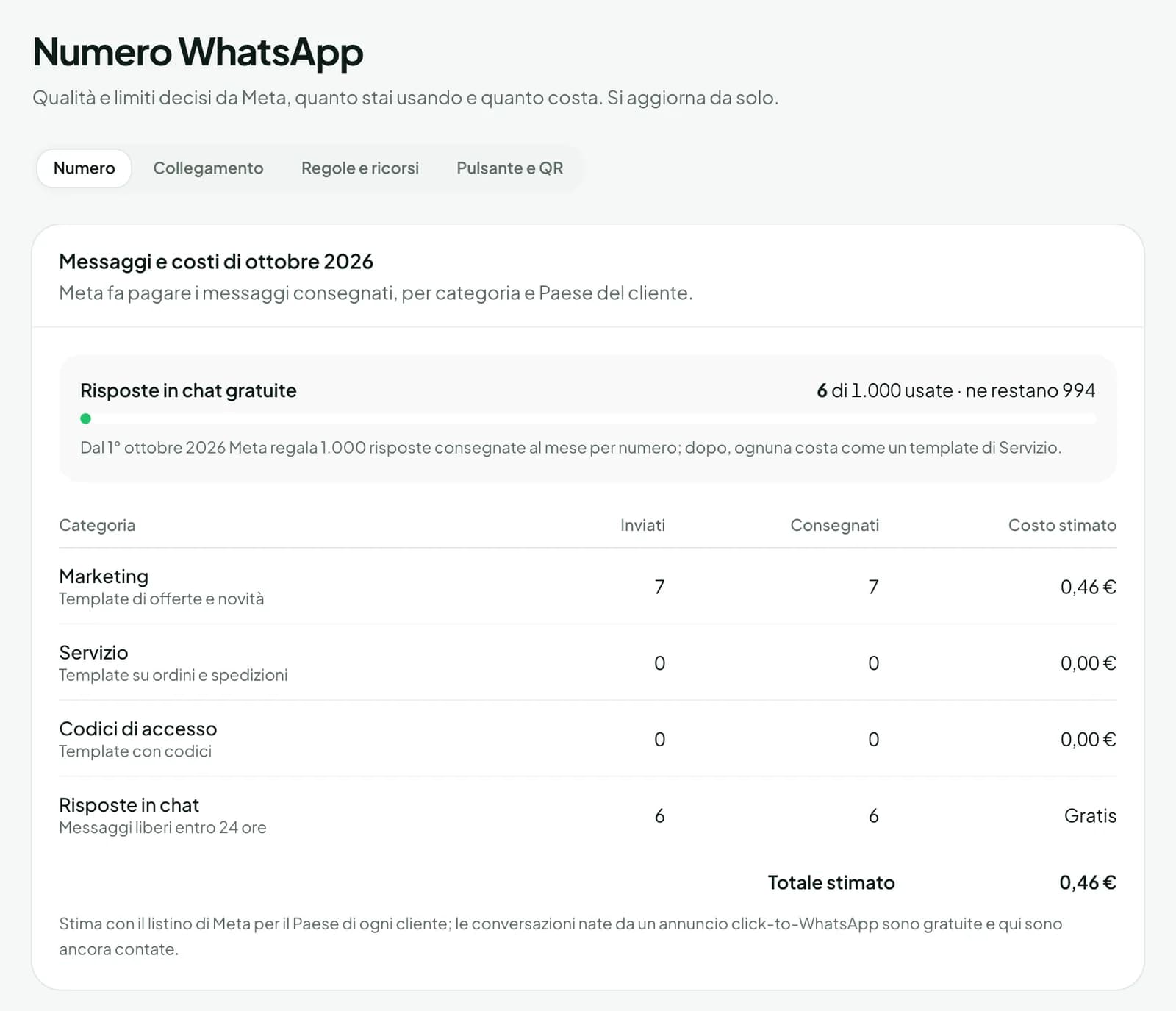
Before every campaign, Gosendly shows you how many people will receive the message and how much it will cost in euros, using Meta's price list and its date. In the chat you can see how much time is left in the 24-hour window and, if it's closed, how much it costs to reopen it with a template. In Settings you'll find the counter for the month's 1,000 free replies, with an alert when they're about to run out.
The sending rules are on by default: at most 2 marketing messages in 7 days per customer, no promotions from 9 p.m. to 9 a.m. in the customer's time zone, and a check that blocks promotions sent as service messages. Their main job is to protect your number, but they also save you money.
Frequently asked questions
Do I pay for messages I receive from customers?
No. Meta only charges for messages the business sends that get delivered. Whatever customers write to you is always free.
How much does it cost to send a campaign to 1,000 customers in Italy?
With a marketing template, as of October 28, 2026, 1,000 delivered messages cost €65.80 (1,000 × €0.0658). If some of the messages aren't delivered, you don't pay for those.
Are chat replies still free?
Yes, up to 1,000 delivered service replies per month for each phone number. From the 1,001st on, since October 1, 2026, each one costs €0.0248 for Italian numbers.
Do I pay for the order confirmation even if the customer just messaged me?
Yes, if you send it as a utility template: since October 1, 2026, Meta charges for utility messages even inside the 24-hour window. A free-form reply written in the chat, on the other hand, counts toward the month's 1,000 free service replies.
Does Gosendly add a markup on Meta's messages?
No. The store pays for messages directly to Meta, using the payment method on its WhatsApp Business account. Gosendly shows the estimate before sending and charges only for the subscription.
Sources
- Meta for Developers: Pricing on the WhatsApp Business Platform(opens in a new tab)Read on October 28, 2026
- Meta for Developers: Non-template messages (service and Meta Business Agent)(opens in a new tab)Read on October 28, 2026
- WhatsApp Business: Business Platform Pricing, rates by market and currency (Italy, EUR)(opens in a new tab)Read on October 28, 2026
- WhatsApp Business: Meta One on WhatsApp Business app(opens in a new tab)Read on October 28, 2026
- Meta for Developers: Solution providers overview(opens in a new tab)Read on October 28, 2026
Keep reading
- Free toolsWhatsApp cost calculatorEnter how many messages you send in a month and where your customers are: the calculator applies Meta's official euro rate card, in effect since…Read
- GuidesWhatsApp Business app vs API: the differencesWhatsApp Business app or API: the choice depends on how many chats you have, who replies and what you want to automate. Here you'll find the…Read
- GuidesWhatsApp messaging limits and how to increase themWhatsApp messaging limits decide how many people you can message first in a day. Here you'll find how they've worked since 2025, the tiers, how to…Read
- GuidesClick-to-WhatsApp ads: the guideClick-to-WhatsApp ads take people from Facebook and Instagram straight into a chat with your store. They work if someone on the other end replies…Read
- FeaturesSending rules that protect your numberA customer who gets too many offers blocks or reports your number, and quality drops for everyone. Gosendly's sending rules apply to campaigns and…Read
- GosendlyPricingRead
More guides
- GuideWhatsApp Business API: the guide for storesThe WhatsApp Business API is how a store connects WhatsApp to its tools: orders, carts, a shared inbox, automations. This guide explains what you really need to activate it, without…
- GuideWhatsApp Business app vs API: the differencesWhatsApp Business app or API: the choice depends on how many chats you have, who replies and what you want to automate. Here you'll find the differences laid out side by side and the signs…
- GuideWhatsApp blue checkmark: how to get itThe blue checkmark on WhatsApp tells customers they really are messaging your store. Today there are two different ways to get it, one for the API platform and one for the app: here you'll…
- GuideWhatsApp messaging limits and how to increase themWhatsApp messaging limits decide how many people you can message first in a day. Here you'll find how they've worked since 2025, the tiers, how to move up and how to plan a Black Friday…
- GuideConsent and GDPR for WhatsApp messagesTo message customers on WhatsApp you need two permissions that go together: the one Meta requires and the one privacy law requires. This guide explains consent and GDPR for WhatsApp…
- GuideWhatsApp for Shopify: the complete guideWhatsApp for Shopify means updating customers on their orders, recovering carts and answering in chat without leaving your store's workflow. This guide starts from what Shopify already…
Sign-ups open soon
Leave your email and we'll tell you when we launch: then you create your account and find a sample store full of data to try right away.
- We'll write to you once
- Every feature when we open
- Sample store already full of data